
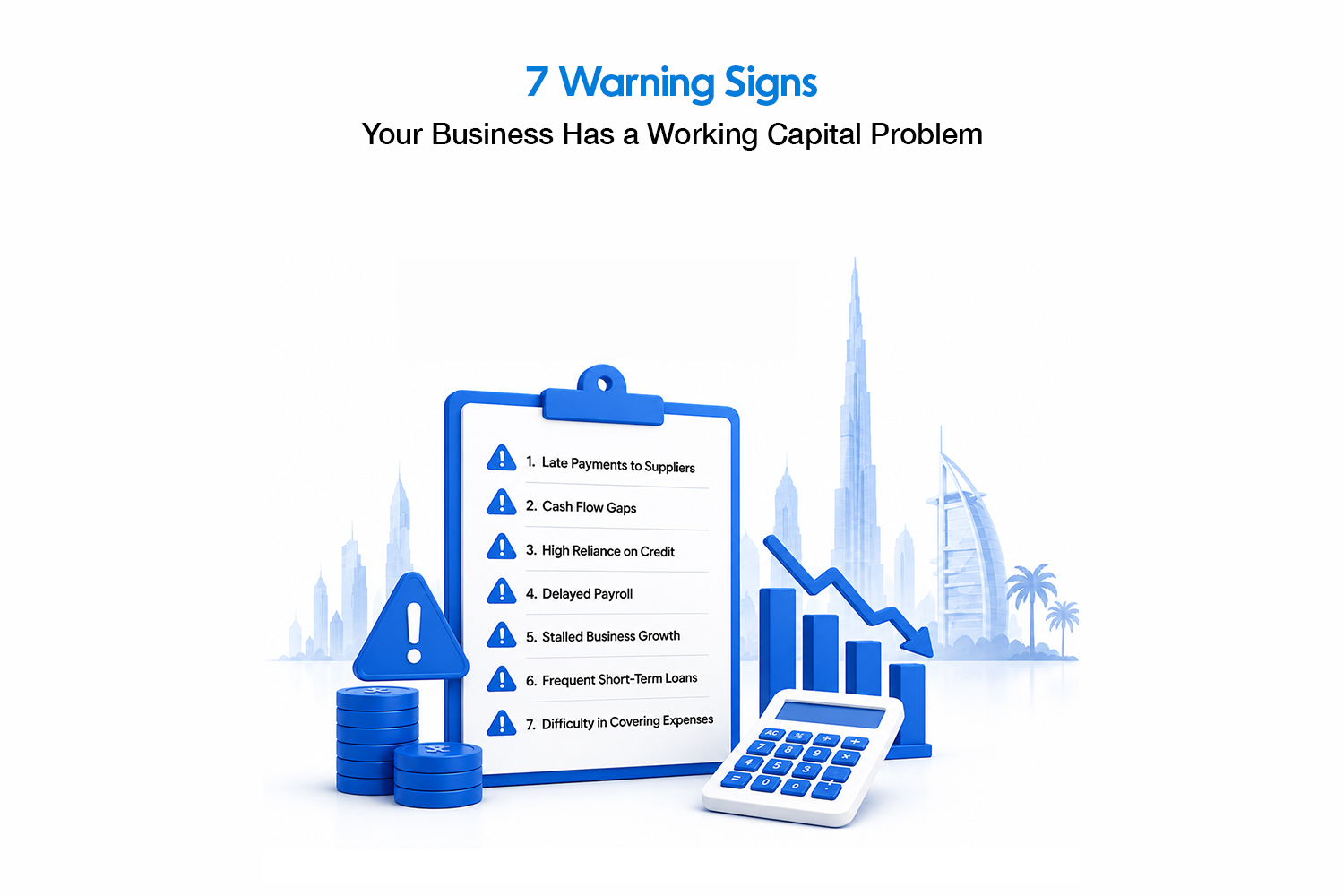
A business can be profitable on paper and still struggle to pay suppliers, employees, or operating expenses on time. This often happens when too much money is tied up in unpaid invoices, inventory, or other short-term assets. When your business cannot comfortably meet its day-to-day financial obligations, it may be experiencing working capital problems. For UAE SMEs, effective working capital management is particularly important when customer payment cycles are long, inventory requirements increase, or the business is growing faster than its available cash. But how do you know when a normal cash-flow challenge has become a serious working capital issue? Here are seven warning signs to watch for.
1. You Regularly Struggle to Pay Suppliers on Time
One of the clearest signs of working capital problems is consistently delaying supplier payments because cash is unavailable. If your customers pay you after 30, 60, or 90 days while suppliers expect payment much sooner, a timing gap can put pressure on your business. Repeatedly asking suppliers for extensions may also affect relationships, purchasing terms, and your ability to negotiate better deals. A healthy business should have enough liquidity to manage its operating cycle without constantly relying on payment extensions.
2. Your Profits Are Increasing, but Cash Is Not
Growing revenue does not automatically mean improving liquidity.
For example, you may record strong sales and profits but have most of your revenue sitting in outstanding invoices. Until customers actually pay, that money cannot be used to purchase inventory, pay expenses, or invest in growth. This is why businesses need to monitor both profitability and cash flow. If your sales are growing but your bank balance remains under pressure, it could be one of the important signs of working capital problems.
3. You Are Constantly Waiting for Customer Payments
Long payment cycles can create significant business cash flow problems, particularly for B2B businesses. Suppose your company completes a large order and issues an invoice for AED 200,000. If the customer pays after 60 days, you may have already incurred costs for inventory, employees, logistics, and operations. The business has earned the revenue, but the cash is still locked in receivables. Invoice discounting can help eligible businesses unlock a portion of the value tied up in outstanding invoices instead of waiting for the full payment cycle. Fincobox offers invoice discounting designed to help UAE businesses access liquidity against eligible invoices.
4. You Are Turning Down Growth Opportunities Because of Cash Constraints
Another important warning sign is having the demand, customers, or opportunity to grow but not enough working capital to act. You might need additional inventory to fulfil a large order, increase marketing spend before a seasonal sales period, or purchase materials for a new contract. If you repeatedly say, “We would do it if we had the cash,” your business may have a working capital shortage. Working capital should support growth rather than become a barrier to it.
5. Inventory Is Taking Too Long to Convert Into Cash
Excess inventory can tie up a significant amount of your business’s cash. If products remain unsold for extended periods, your money is effectively sitting in stock instead of being available for salaries, suppliers, marketing, or expansion. On the other hand, insufficient inventory can cause stockouts and lost sales. Effective working capital management therefore requires balancing inventory levels with actual demand, sales cycles, and cash availability. For e-commerce, D2C, manufacturing, and retail businesses, this becomes especially important during seasonal demand or rapid expansion.
6. You Depend on Credit to Cover Everyday Expenses
Using short-term credit occasionally is not necessarily a problem. However, if your business regularly needs external credit simply to cover routine expenses, it may indicate an underlying working capital issue. For example, repeatedly borrowing to pay suppliers, salaries, rent, or operating expenses can indicate that your cash conversion cycle needs attention. The goal should be to use financing strategically to bridge genuine timing gaps or support growth rather than constantly covering an unsustainable cash deficit.
7. Your Business Growth Is Creating More Financial Pressure
It may sound surprising, but rapid growth can actually create working capital problems.
Imagine your sales increase by 50%. That sounds positive, but you may simultaneously need to:
- Purchase more inventory
- Hire additional employees
- Spend more on marketing
- Fulfil larger orders
- Pay suppliers earlier
- Wait longer for some customers to pay
As a result, faster growth can require more working capital before the additional revenue reaches your bank account. For UAE SMEs experiencing this situation, flexible liquidity solutions can help bridge short-term gaps while the business continues growing. Fincobox provides solutions including Revenue-Based Liquidity, Invoice Discounting, Short-Term Working Capital, and Purchase Order Liquidity for eligible UAE SMEs.
How Can Businesses Solve Working Capital Problems?
The first step is identifying exactly where cash is getting stuck.
Review your:
- Accounts receivable and outstanding invoices
- Inventory turnover
- Supplier payment terms
- Customer payment cycles
- Operating expenses
- Cash conversion cycle
- Short-term financing requirements
Once you identify the gap, you can determine whether the solution involves improving collections, negotiating supplier terms, reducing excess inventory, improving forecasting, or accessing appropriate working capital financing in the UAE. For businesses with eligible outstanding invoices, invoice discounting can provide access to liquidity without waiting for customers to complete their payment cycle. Fincobox states that its invoice discounting solution can provide eligible businesses with up to 90% of invoice value, subject to its assessment and applicable terms. For businesses with consistent revenue, Fincobox also offers Revenue-Based Liquidity, where funding is linked to business revenue rather than relying solely on a traditional fixed repayment structure.
Final Thoughts
Working capital problems rarely appear overnight. Delayed supplier payments, increasing receivables, slow-moving inventory, cash shortages, and missed growth opportunities can all signal that your business liquidity needs attention. The good news is that identifying these warning signs early gives you more options. For UAE SMEs, better cash-flow forecasting combined with the right financing strategy can help maintain liquidity while supporting sustainable growth. Fincobox provides non-dilutive liquidity solutions designed around different business needs, including invoice discounting, revenue-based liquidity, short-term working capital, and purchase order liquidity. If your business is growing but cash flow is constantly under pressure, it may be time to look beyond revenue and start focusing on your working capital cycle.
Frequently Asked Questions
1. What are working capital problems?
Working capital problems occur when a business does not have sufficient short-term liquidity to comfortably manage its day-to-day financial obligations. They can arise from delayed customer payments, excess inventory, high operating costs, or mismatched payment cycles.
2. What are the common signs of working capital problems?
Common signs include regularly delaying supplier payments, struggling to cover operating expenses, waiting too long for customer payments, relying heavily on short-term credit, holding excess inventory, and missing growth opportunities because of cash constraints.
3. Why can a profitable business have working capital problems?
Profit and cash flow are not the same. A business can report revenue and profit while its cash remains tied up in unpaid invoices or inventory. This can create a liquidity gap even when the company is profitable.
4. How can SMEs improve working capital?
SMEs can improve working capital by collecting receivables faster, managing inventory efficiently, negotiating supplier terms, monitoring expenses, forecasting cash flow, and using appropriate financing solutions when necessary.
5. What is working capital financing in the UAE?
Working capital financing provides businesses with liquidity to manage short-term operational requirements and cash-flow gaps. Depending on the business and eligibility, options can include invoice discounting, revenue-based liquidity, and other short-term financing solutions.
6. Can Fincobox help with working capital problems?
Yes. Fincobox provides liquidity solutions for eligible UAE SMEs, including Invoice Discounting, Revenue-Based Liquidity, Short-Term Working Capital, and Purchase Order Liquidity. These solutions are designed to help businesses manage liquidity gaps and support growth. (Fincobox)
7. Is invoice discounting suitable for every business?
Not necessarily. It is generally most relevant to businesses with eligible outstanding invoices and established customer payment cycles. Fincobox evaluates business and financial information before determining eligibility and applicable funding terms. (Fincobox)
Leave a Reply