
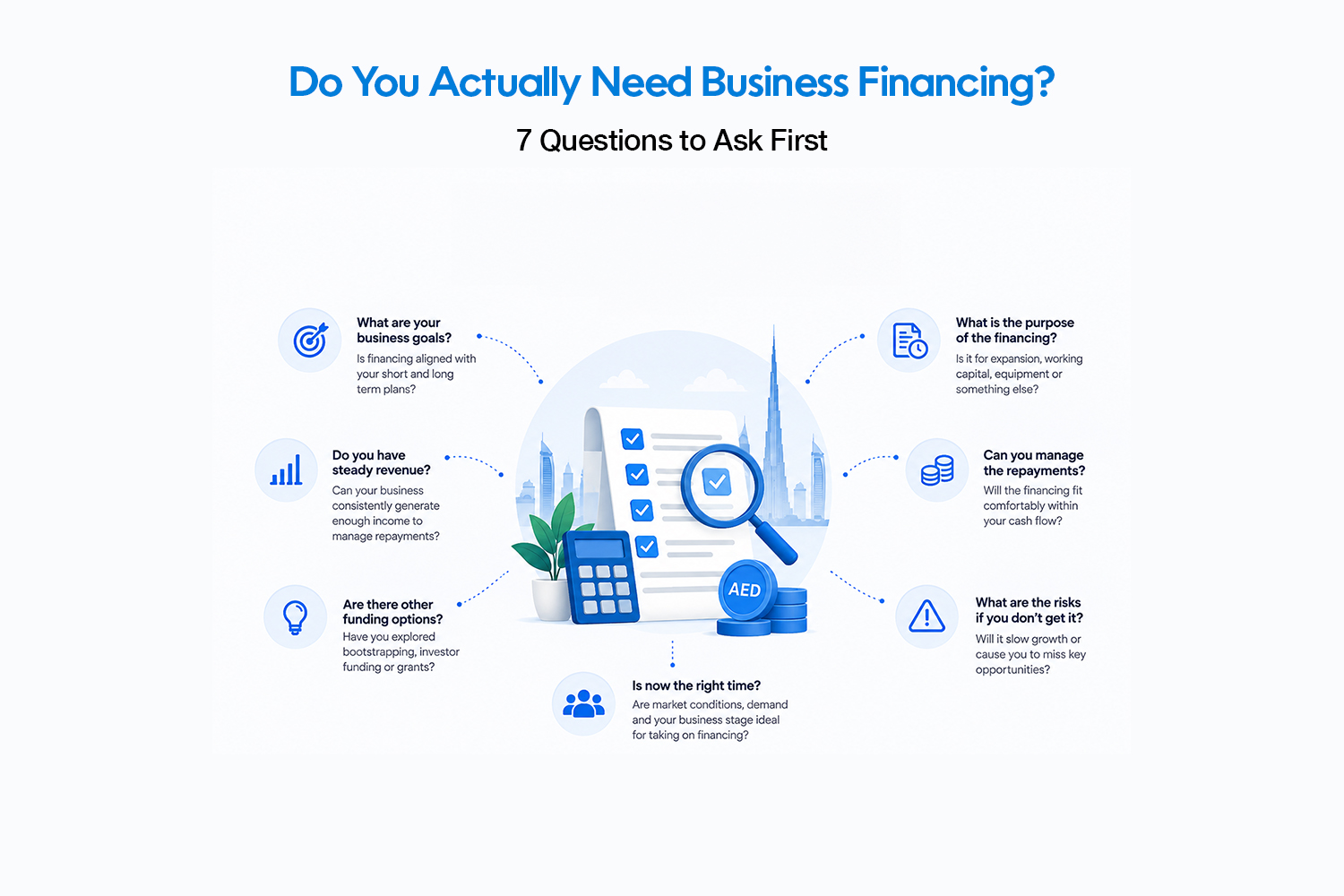
Your business is growing, but your cash balance doesn’t always tell the same story. You may have more customers, larger orders and stronger sales than ever, yet still find yourself wondering whether there is enough cash to pay suppliers, purchase inventory, fund marketing or take on your next opportunity. That is when business financing starts to look attractive. But here is the question many business owners skip:
Do you actually need financing or do you need to fix a cash-flow problem first?
For UAE SMEs, the answer depends on why you need the money, how quickly you need it and whether the funding will create enough business value to justify its cost. Before applying for business financing in the UAE, ask yourself these seven questions.
1. What exactly do I need the money for?
Start with the problem, not the financial product. Are you short of cash because:
- Customers are taking 60 or 90 days to pay?
- You need to purchase inventory before a busy season?
- You have received a large purchase order?
- You want to increase marketing spend?
- You need to cover a temporary working-capital gap?
- You are expanding into a new market?
- Your business is consistently spending more than it earns?
These are very different situations. For example, a business waiting for customers to pay may need invoice discounting, while an e-commerce business with consistent revenue may consider revenue-based liquidity. The right business financing solution starts by identifying the reason behind the cash requirement.
2. Is the problem temporary or structural?
This may be the most important question on the list. If your business has a temporary cash-flow gap because customers pay later than you need to pay suppliers, financing could potentially bridge that timing difference. But if your business consistently loses money, financing may simply delay the underlying problem.
Before applying, look at your:
- Revenue
- Gross margins
- Operating expenses
- Customer payment cycles
- Supplier payment terms
- Monthly cash flow
If the business model is fundamentally healthy but cash arrives at the wrong time, financing can potentially be useful. If the business is structurally unprofitable, however, borrowing more money may not solve the problem.
3. Will the financing help me make or save money?
Don’t ask only, “How much funding can I get?”
Ask: “What will this money do for my business?”
Suppose you need AED 150,000 to purchase inventory for products that consistently sell out. If that inventory allows you to generate significantly more revenue, the financing could have a clear commercial purpose. The same applies to a marketing campaign, new customer acquisition opportunity or large confirmed order. On the other hand, using short-term financing to repeatedly cover an operating deficit requires much more careful consideration. A useful rule is: Financing should have a clear job to do.
4. Is my cash stuck in invoices?
Sometimes, you don’t actually need to borrow money, you need earlier access to money your business has already earned. Imagine your company has completed a AED 200,000 B2B sale and issued an invoice, but the customer will pay in 60 days. Your business may be profitable, but AED 200,000 is still tied up in receivables. This is where invoice discounting can become relevant Fincobox offers invoice discounting for eligible UAE businesses and states that businesses can access up to 90% of eligible invoice value, subject to assessment and applicable terms. Instead of waiting for the entire payment cycle, an eligible business can potentially unlock part of that receivable as working capital.
5. Do I need a traditional business loan?
Not necessarily. Traditional loans are only one of several business financing options available to UAE SMEs.
Depending on your situation, you may consider:
| Your situation | Potential financing option |
| Cash tied up in unpaid invoices | Invoice discounting |
| Consistent revenue + growth opportunity | Revenue-based liquidity |
| Large confirmed customer order | Purchase order liquidity |
| Short-term operating cash gap | Short-term working capital |
Fincobox offers these types of liquidity solutions for eligible UAE SMEs. The important point is that these products are not interchangeable. Your financing choice should match the underlying business need.
6. Can my business comfortably support the financing?
Getting approved doesn’t automatically mean financing is affordable. Before accepting an offer, understand:
- Total financing cost
- Fees
- Repayment or settlement structure
- Financing period
- Expected cash inflows
- What happens if sales decline
- Your expected return from using the capital
You should be able to explain exactly how and when the financing will be settled. Fincobox states that every registered SME goes through a credit underwriting process before receiving a detailed offer containing the applicable terms and limits. That assessment is important because the right amount of financing depends on the individual business not simply on what a company requests.
7. Am I financing growth or financing a problem?
This is the final reality check. Growth financing can make sense when you have a proven business model and a specific opportunity that requires additional working capital.
For example:
More inventory → more sales → more revenue.
Or:
Larger order → financing for fulfilment → completed order → customer payment.
But if the cycle looks more like: Losses → financing → more losses → more financing, then the issue is probably bigger than a temporary cash-flow gap. Financing should support a healthy business strategy, not replace one.
How Much Business Financing Do UAE SMEs Actually Need?
There is no universal amount. A small business may need AED 50,000 to bridge an inventory cycle, while another company may require several hundred thousand dirhams to fulfil a major order or expand. The right amount should be based on: Funding requirement + timing + repayment capacity + expected business return. This is particularly important because taking more financing than you need can increase your overall financing cost.
UAE SMEs Are Still Focused on Growth
The demand for funding is closely connected to the growth ambitions of UAE businesses. According to Mastercard’s 2026 SME Confidence Index, 83% of UAE SMEs surveyed reported revenue growth over the previous 12 months, while 50% said they were seeking access to credit to support growth. (Mastercard)
The takeaway is important: financing isn’t necessarily about keeping a struggling business alive. For many SMEs, access to capital is also about having the resources to pursue growth opportunities.
Where Does Fincobox Fit In?
Fincobox provides non-dilutive liquidity solutions for eligible UAE SMEs, including invoice discounting, revenue-based liquidity, short-term working capital and purchase order liquidity. The advantage of approaching financing this way is that you can start with your business problem.
Unpaid invoice? Explore invoice discounting.
Consistent revenue and a growth opportunity? Consider revenue-based liquidity.
Large customer order? Look at purchase order liquidity.
Temporary operating gap? Short-term working capital may be more relevant.
Fincobox also states that its liquidity is non-dilutive, meaning businesses retain ownership and control rather than giving up equity for funding.
So, Do You Actually Need Business Financing?
Before you apply, ask yourself these seven questions:
- What exactly do I need the money for?
- Is my cash-flow problem temporary or structural?
- Will the financing help me make or save money?
- Is my cash already tied up in invoices?
- Do I really need a traditional business loan?
- Can my business comfortably support the financing?
- Am I financing growth or financing a problem?
If you have clear answers, you are in a much stronger position to decide whether financing makes sense and which type may fit your business. For UAE SMEs, the goal shouldn’t simply be to get business financing. It should be to get the right financing for the right business need at the right time. And if your business has a specific working-capital or growth requirement, Fincobox gives eligible UAE SMEs multiple liquidity options to explore based on their circumstances.
Frequently Asked Questions
1. When does a business actually need financing?
A business may need financing when it has a temporary working-capital gap, an opportunity for profitable growth, unpaid invoices tying up cash, inventory requirements or a large order that requires upfront expenditure.
2. Is business financing the same as a business loan?
No. A traditional business loan is only one type of business financing. SMEs can also explore solutions such as invoice discounting, revenue-based liquidity, purchase order financing and other working-capital facilities.
3. What is the best business financing option for an SME in the UAE?
There is no single best option. It depends on why the business needs capital. For example, invoice discounting may suit a company waiting for customer payments, while revenue-based liquidity may be relevant to a business with consistent revenue and a growth opportunity.
4. Can I get business financing without giving up equity?
Some financing structures are non-dilutive, meaning the business does not have to sell ownership to receive capital. Fincobox states that its liquidity solutions are 100% non-dilutive.
5. How much business financing should I apply for?
You should generally base the amount on your specific funding requirement, expected cash inflows, repayment capacity and the commercial return you expect from using the capital. Avoid taking more financing than your business can reasonably deploy and support.
6. Does Fincobox offer different business financing solutions?
Yes. Fincobox offers invoice discounting, revenue-based liquidity, short-term working capital and purchase order liquidity for eligible UAE SMEs.
7. Is Fincobox business financing available to UAE SMEs?
Fincobox is a UAE-focused digital platform offering non-dilutive working-capital solutions to SMEs. Its stated eligibility criteria include MSMEs, D2C and e-commerce businesses with 6+ months of operating history and AED 100,000+ in monthly revenue, subject to assessment. (Fincobox)
8. What should I check before accepting business financing?
Review the total cost, fees, repayment or settlement structure, financing period, cash-flow impact and your expected return from using the funds. You should also make sure the financing actually addresses the underlying business need.
Leave a Reply