
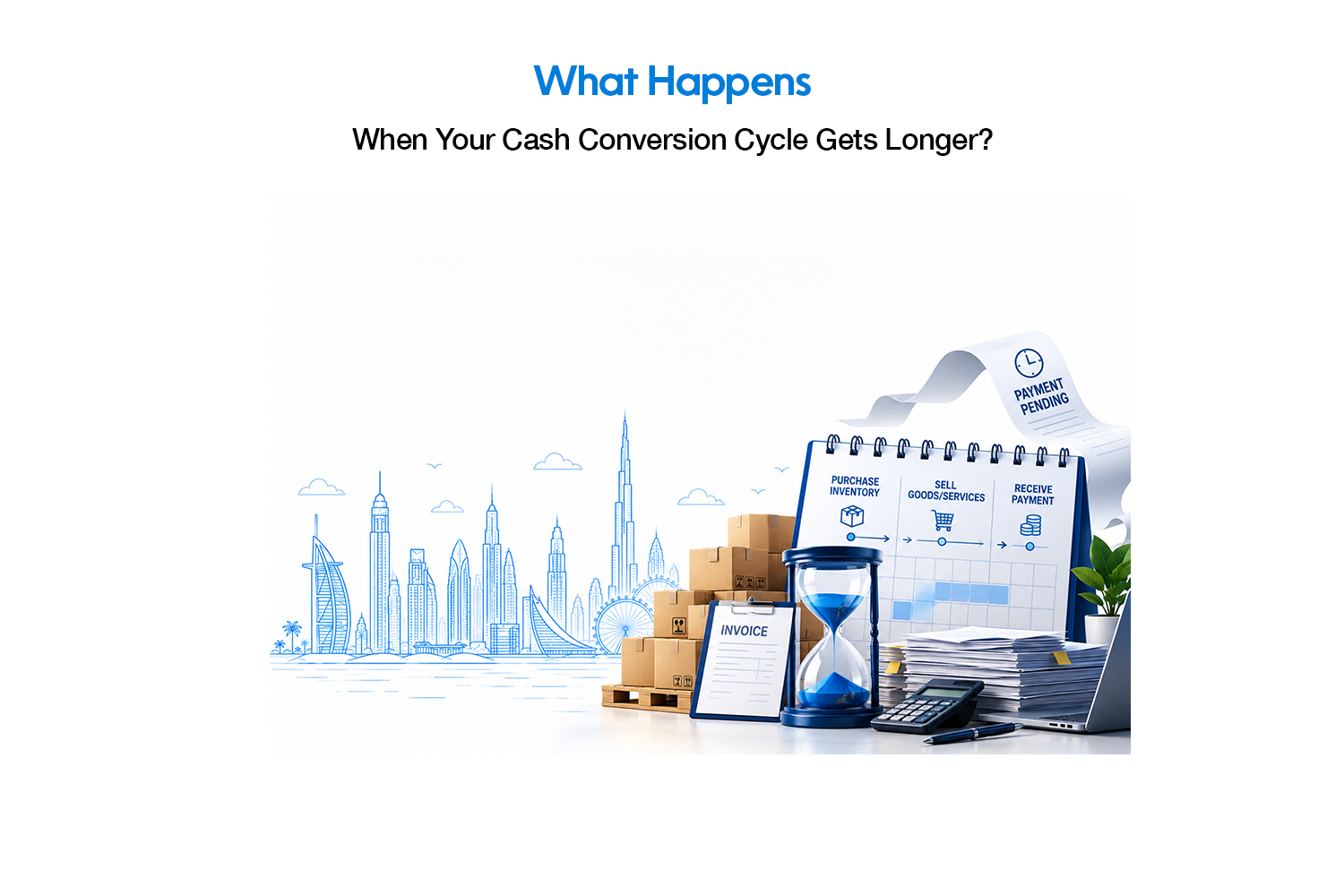
Imagine your sales are growing, new customers are coming in and your order book looks stronger than ever. Yet, every month, you still find yourself asking: “Why do we have so much business but not enough cash?” For many growing businesses, the problem is not a lack of sales. It is timing. Customers may take longer to pay. Inventory may sit in the warehouse for longer. Suppliers may shorten their payment terms. Each change means more cash stays tied up inside the business. This is where the cash conversion cycle (CCC) becomes important.
What Is the Cash Conversion Cycle?
The cash conversion cycle measures how long it takes for the money a business puts into its operations to come back as collected cash.
The basic formula is:
Cash Conversion Cycle = Inventory Days + Receivable Days − Payable Days
In simple terms, it answers:
How long does my money stay tied up before it comes back into the business?
A simple UAE example
Consider a Dubai-based distributor:
- Inventory is held for 30 days
- Customers take 60 days to pay
- Suppliers give 30 days to pay
So:
30 + 60 − 30 = 60-day Cash Conversion Cycle
The business effectively has to fund around 60 days of its operating cycle.
Now imagine customers start taking 90 days to pay.
30 + 90 − 30 = 90 days
The business has just added 30 days to its cash requirement, even though its sales process has not changed.
What happens when each part changes?
| Change | Example | Impact on CCC |
| Customers pay later | Receivables: 60 → 90 days | +30 days |
| Inventory sells slower | Inventory: 30 → 45 days | +15 days |
| Suppliers give less time | Payables: 30 → 15 days | +15 days |
| Suppliers give more time | Payables: 30 → 45 days | −15 days |
This is why a business can suddenly need more working capital without actually becoming less profitable.
Why Does a Longer Cash Conversion Cycle Matter?
A longer CCC means more money is committed to day-to-day operations before it returns as cash.
For a UAE SME, that can affect the ability to:
- Pay suppliers on time
- Replenish inventory
- Fund payroll and operating expenses
- Spend on marketing
- Take on larger customer orders
- Invest in expansion
The impact becomes more noticeable as the business grows. For example, suppose a UAE B2B company invoices AED 1 million every month. If customers pay in 30 days, roughly one month’s sales may be sitting in receivables. If the average collection period moves to 90 days, the business could have substantially more cash tied up in outstanding invoices. The company may still be profitable. It simply has to wait longer to access the cash generated by its sales.
What Makes the Cash Conversion Cycle Longer?
There are three main areas to watch: receivables, inventory and payables.
1. Customers Are Taking Longer to Pay
This is one of the most common reasons a company’s CCC increases. A UAE wholesaler might have 30-day payment terms on paper, but some customers may actually pay in 45, 60 or even 90 days. For a business invoicing AED 500,000 a month, an additional 30 days in collections can leave a significant amount of additional capital sitting in receivables. Before looking for financing, check why payments are late. Common causes include:
- Invoice errors
- Customer approval delays
- Disputes
- Weak collection follow-up
- Informal extensions of credit
- Customers consistently paying beyond agreed terms
Improving collections can sometimes release cash without taking on additional financing. But when long payment cycles are a normal part of the business, receivables finance or invoice discounting UAE solutions may help bridge the gap. For eligible businesses, Fincobox’s Invoice Discounting is designed to unlock liquidity against outstanding invoices rather than requiring the business to wait until the full customer payment cycle is complete.
2. Inventory Is Taking Longer to Sell
Inventory is another common cash-flow drain. Consider a UAE e-commerce business preparing for Ramadan or another major sales period. It purchases AED 400,000 of inventory, expecting most of it to sell within 30 days. But demand is slower than expected, and after a month, only half the stock has moved. The remaining AED 200,000 is not necessarily a loss. But it is also not available to:
- Purchase faster-moving products
- Pay suppliers
- Fund marketing
- Cover operating expenses
The issue is therefore not simply how much inventory a business holds. It is how quickly that inventory turns back into cash. Before using financing to purchase more stock, businesses should look at inventory turnover, margins and actual demand. Where a business has established revenue and needs capital for inventory or growth, Fincobox’s Revenue-Based Liquidity may be relevant for eligible businesses.
3. Suppliers Want Payment Sooner
The third part of the CCC equation is often overlooked.
Imagine a UAE distributor whose:
- Customers pay in 60 days
- Suppliers give 45 days
The business already has a 15-day gap to manage. If the supplier changes the terms to 30 days, the gap becomes:
60 − 30 = 30 days
The customers have not changed. Sales have not changed.But the business now needs to fund an additional 15 days. This is why supplier negotiations can have a meaningful effect on business liquidity UAE. Depending on the transaction, businesses may also explore options such as payable financing, vendor finance or supply-chain finance.
Why Growth Can Increase Your Cash Requirement
One of the less obvious realities of business growth is that more sales can require more cash. Imagine a UAE company growing from AED 200,000 to AED 1 million in monthly sales. At AED 200,000 a month, customers paying within 30 days may leave a manageable amount in receivables. At AED 1 million a month, if customers take 60–90 days to pay, the amount tied up in receivables can increase significantly. And growth may also require:
- More inventory
- More employees
- More logistics
- More marketing
- Larger supplier payments
So the business may be generating more revenue while simultaneously needing more working capital UAE to support that revenue. This is why cash planning becomes increasingly important as an SME scales.
Profit Is Not the Same as Cash
A business can be profitable and still have a cash-flow problem. Consider a UAE company that makes a AED 200,000 sale in September, but the customer is not due to pay until November. The sale contributes to revenue and potentially profit, but the AED 200,000 is not yet available in the company’s bank account. Meanwhile, the business may have supplier invoices, payroll and operating expenses due today. That is the practical difference between profit and cash flow. Profit tells you what the business earned. Cash flow tells you when that money is actually available to use. For businesses with long payment cycles, that timing difference can create a genuine liquidity requirement even when underlying sales are healthy.
What Should You Do When Your Cash Conversion Cycle Gets Longer?
Before looking for business financing UAE, find out what has actually changed.
Start with receivables
Compare your contractual payment terms with your actual collection period. If customers are supposed to pay in 30 days but are actually paying in 55 days, investigate why. Improving collections may be the simplest way to release cash.
Review inventory
Look at:
- Which products are moving slowly?
- How long has stock been sitting?
- Are you purchasing based on actual demand?
- Are seasonal assumptions still accurate?
The goal is not necessarily to hold less inventory. It is to hold the right inventory at the right time.
Review supplier terms
If your business has a strong payment history, consider whether suppliers may offer longer payment terms. Moving from 30-day to 45-day terms, for example, can give the business additional time to collect customer payments before paying suppliers.
Then consider financing
If the longer cycle is a normal part of the business rather than a temporary problem, financing may help bridge the timing gap. The important part is matching the financing to the reason cash is tied up.
Where Different Fincobox Solutions Can Fit
Different cash-flow problems call for different financing structures. For eligible UAE businesses, Fincobox offers several non-dilutive liquidity solutions that correspond to different points in the cash conversion cycle.
Cash is tied up in unpaid invoices?
Invoice Discounting can help eligible businesses unlock liquidity against outstanding invoices instead of waiting for the entire customer payment cycle.
You have consistent revenue but need capital for growth or inventory?
Revenue-Based Liquidity is designed for businesses with established revenue that need funding for growth-related requirements.
You need short-term cash for operational requirements?
Short-Term Working Capital can help address temporary funding needs across the operating cycle. You have a confirmed customer order but need capital to fulfil it?
Purchase Order Liquidity is designed to help eligible businesses fund qualifying purchase orders before receiving customer payment. The point is not to choose financing first. It is to identify where the cash-flow gap is, then assess whether financing is an appropriate way to bridge it. Fincobox’s solutions are non-dilutive, meaning businesses do not exchange ownership for the financing.
5 Warning Signs Your Cash Conversion Cycle Needs Attention
You do not need to wait until cash becomes critically tight.
Watch for these signs:
1. Sales are rising, but available cash is not.
Revenue is growing, but the bank balance is not keeping pace.
2. Receivables are growing faster than revenue.
Customers are taking longer to pay or outstanding invoices are accumulating.
3. Inventory keeps building.
Stock is increasing without a corresponding increase in sales.
4. Supplier payment extensions are becoming routine.
Repeatedly asking suppliers for more time can point to a working capital gap.
5. You are turning down orders because you cannot fund them.
When lack of liquidity starts limiting your ability to accept profitable business, cash flow has become a growth constraint.
The Bottom Line
Your cash conversion cycle is more than an accounting formula.
It tells you how long your money is tied up before it returns to the business. When customers pay later, inventory moves more slowly or suppliers require payment sooner, the cycle gets longer and your working capital requirement can increase. The first response does not always need to be financing. Start by improving collections, reviewing inventory and negotiating supplier terms. But if a longer cash cycle is a normal part of how your business operates, the right cash flow solutions UAE can help you manage the gap without allowing working capital constraints to slow down growth. For eligible UAE SMEs, options such as invoice discounting, revenue-based liquidity, short-term working capital and purchase-order liquidity can address different cash-flow requirements. Because ultimately, a growing business needs more than sales. It needs enough liquidity to keep operating while it waits for those sales to turn back into cash. Revenue tells you how much you sold. Your cash conversion cycle tells you how long you have to wait to use that money.
Frequently Asked Questions
What is a cash conversion cycle?
The cash conversion cycle measures how long it takes for a business to convert money invested in inventory and operations back into collected cash from customers.
What causes the cash conversion cycle to increase?
The CCC can increase when customers take longer to pay, inventory takes longer to sell, or suppliers require payment sooner.
Is a longer cash conversion cycle bad for an SME?
Not necessarily. Some industries naturally operate with longer cash cycles. The key question is whether the business has enough working capital and liquidity to support that cycle.
How can a business shorten its cash conversion cycle?
Businesses can improve collections, reduce unnecessary inventory, improve inventory turnover and negotiate suitable supplier payment terms.
Can invoice discounting help with cash flow?
For eligible businesses with qualifying outstanding invoices, invoice discounting can provide access to part of the invoice value before the customer makes the payment, subject to the provider’s assessment and terms.
What is revenue-based financing?
Revenue-based financing is a form of business financing where repayment is structured around a company’s revenue or sales performance rather than exchanging equity for capital. The exact structure varies by provider.
What is purchase order financing?
Purchase order financing provides capital to help eligible businesses fulfil confirmed purchase orders, particularly when they need to pay suppliers or purchase materials before receiving payment from the customer.
Does Fincobox provide working capital solutions in the UAE?
Yes. Fincobox currently offers Invoice Discounting, Revenue-Based Liquidity, Short-Term Working Capital and Purchase Order Liquidity for eligible UAE businesses.
Can a business be profitable but still have cash-flow problems?
Yes. A business may record revenue and profit from sales while the corresponding cash remains tied up in unpaid invoices or inventory. This is why cash-flow management remains important even when sales and profitability are healthy.
Leave a Reply