
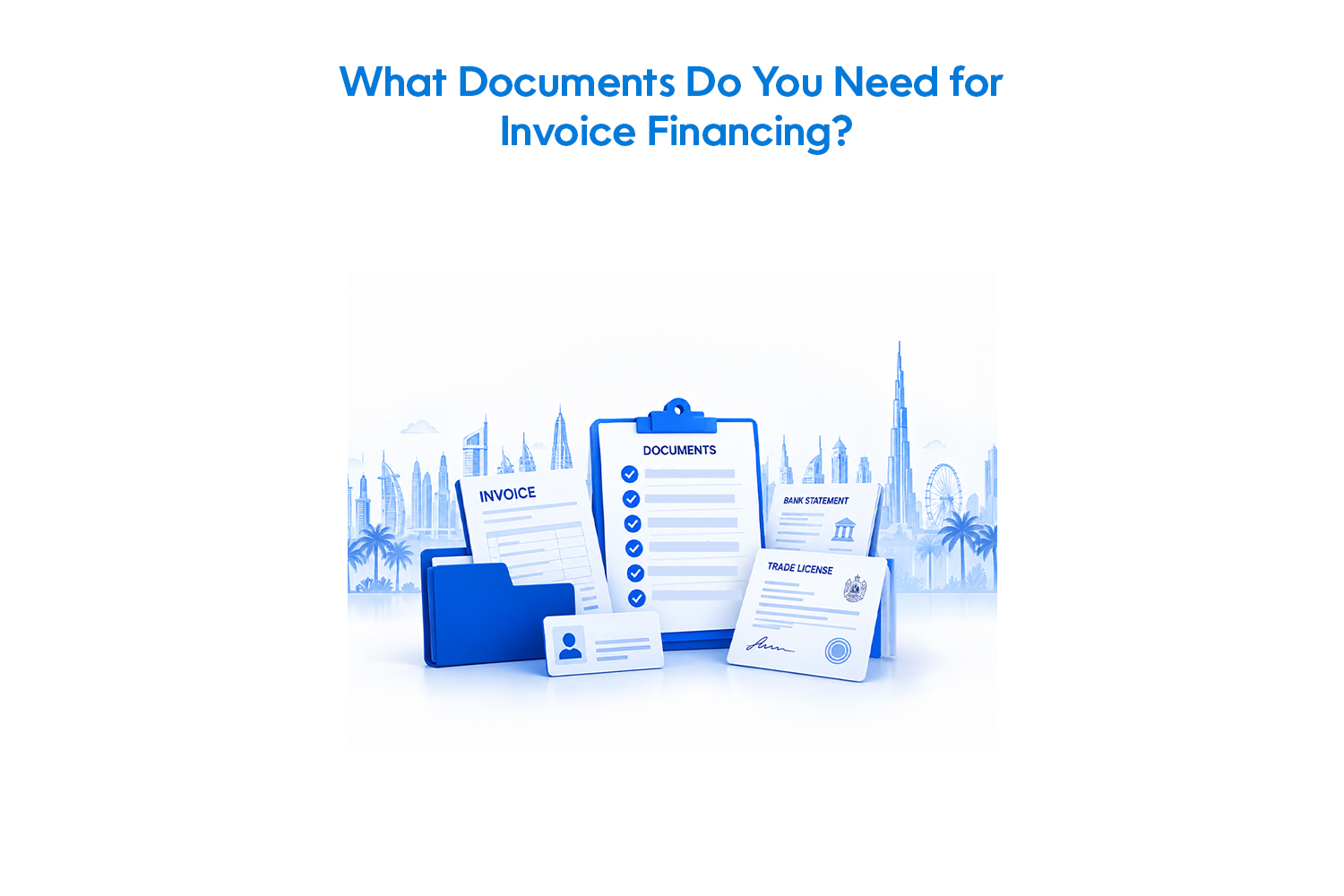
If your business has completed a sale but your customer has not paid yet, the money may be sitting in your accounts receivable instead of being available for day-to-day use. Invoice financing can help eligible businesses access working capital against outstanding invoices rather than waiting for the full payment cycle.
But what documents do you need to apply? For UAE SMEs considering an invoice discounting solution in the UAE, having the right documents ready can make the assessment process more straightforward and help a financing provider understand your business, customer and underlying transaction.
What Is Invoice Financing?
Invoice financing is a working capital solution that allows a business to access funds against eligible unpaid invoices. Instead of waiting 30, 60 or 90 days for a customer to pay, an approved business may receive an advance against the invoice. The facility is then settled according to the agreed terms when the customer payment is received. For UAE SMEs, this can be useful when sales are healthy but cash flow is temporarily tied up in receivables.
The advance percentage, fees, repayment structure and eligibility criteria vary by provider and business.
What Documents Are Needed for Invoice Financing?
The exact requirements depend on the financing provider, your business and the invoices being financed. However, businesses should generally be prepared to provide the following.
1. The Invoice You Want to Finance
The invoice is one of the most important documents in the application.
It should clearly show:
- Your business name and details
- Customer or buyer details
- Invoice number
- Invoice amount
- Issue date
- Payment due date
- Agreed payment terms
- Description of the goods or services provided
The provider uses this information to assess the receivable and determine whether the invoice is eligible for financing.
2. Valid UAE Trade Licence
A valid UAE trade licence is commonly required to verify that your business is legally registered and operating.
Depending on the provider and company structure, you may also need additional corporate documents, such as your Memorandum of Association or other registration records.
3. Recent Business Bank Statements
Bank statements give the financing provider visibility into your company’s financial activity and cash flow.
You may be asked for several months of corporate bank statements. The exact period varies by provider. For example, Kema’s guidance for UAE SMBs refers to 6–12 months of bank statements as a common requirement.
These statements can help providers understand your business activity, incoming payments and overall financial position.
4. Purchase Orders, Contracts or Commercial Agreements
Supporting documents can help establish the relationship between your business and the customer.
Depending on the transaction, these may include:
- Purchase orders
- Sales contracts
- Work orders
- Service agreements
- Other commercial agreements
For example, if your company supplied goods under a purchase order, the PO can help demonstrate what the invoice relates to and support its validity.
5. Proof of Delivery or Service Completion
Providers may also require evidence that the goods or services linked to the invoice have actually been delivered or completed.
This could include:
- Delivery notes
- Goods received notes
- Completion certificates
- Service confirmations
- Shipping documents
- Other proof of fulfilment
This documentation is particularly useful because it connects the invoice to a completed commercial transaction.
6. Company and KYC Documents
You may also need documents that verify the company, its owners and authorised representatives.
These can include:
- Memorandum of Association (MOA)
- Articles of Association, where applicable
- Passport copies
- Emirates IDs
- Shareholder information
- Details of authorised signatories
- Other KYC or compliance documents
The exact requirements depend on the provider and your company’s legal structure.
Does Every Invoice Qualify for Invoice Financing?
No. Having an unpaid invoice does not automatically mean it can be financed.
Providers may assess:
- The business issuing the invoice
- The customer who owes the money
- Invoice value
- Payment terms
- Whether the goods or services have been delivered
- Whether the invoice is disputed
- Supporting transaction documents
- The overall financial profile of the business
In general, clear, verifiable invoices supported by proper commercial documentation are easier to assess.
Why Does Documentation Matter?
Good documentation helps a provider answer three basic questions:
1. Is the business legitimate and financially active?
Your trade licence, company documents and bank statements help establish this.
2. Is the customer and receivable credible?
The invoice, payment terms and customer information provide context around the money owed.
3. Did the underlying transaction actually take place?
Purchase orders, contracts and delivery or completion evidence help establish this. Preparing these documents in advance can reduce unnecessary back-and-forth and make the application process more efficient.
How Fincobox Can Help UAE SMEs
For businesses with cash tied up in outstanding invoices, the benefit of invoice discounting is simple: you can potentially access working capital before your customer pays. Fincobox provides digital-first liquidity solutions for UAE businesses, including Invoice Discounting. Its website states that eligible businesses can access up to 90% of invoice value within 24 hours, subject to assessment and applicable terms. Fincobox also states that its liquidity solutions require no collateral.
For an SME, access to that liquidity can help with practical needs such as:
- Paying suppliers on time
- Managing payroll and operating expenses
- Replenishing inventory
- Fulfilling new orders
- Taking advantage of growth opportunities
- Bridging short-term cash-flow gaps
Instead of allowing an outstanding invoice to keep working capital locked up, businesses can potentially put that receivable to work sooner. Fincobox also uses a digital-first process, helping businesses submit information and documents for assessment without relying on a lengthy traditional financing process.
As with any financing facility, the amount available, approval and terms depend on the business, invoice and assessment.
A Simple Invoice Financing Document Checklist
Before applying, it can help to have these documents ready:
- ✅ Valid UAE trade licence
- ✅ Invoice or invoices you want to finance
- ✅ Recent corporate bank statements
- ✅ Purchase order or customer contract, where applicable
- ✅ Proof of delivery or service completion
- ✅ Company registration documents
- ✅ Identification documents for relevant owners or authorised signatories
- ✅ Any additional customer or transaction information requested by the provider
The better organised your records are, the easier it can be for a provider to understand the business and the receivables being financed.
Final Thoughts
Invoice financing can help UAE SMEs access working capital tied up in eligible outstanding invoices instead of waiting for the full customer payment cycle. While requirements vary between providers, businesses should generally be prepared with their trade licence, invoices, bank statements and supporting transaction documents. If your business regularly waits weeks or months for customers to pay, an invoice discounting solution in the UAE could be worth exploring as part of your working capital strategy. Fincobox offers invoice discounting and other invoice financing solutions designed to help eligible UAE businesses improve liquidity and manage cash-flow gaps. Its current website states that businesses may access up to 90% of eligible invoice value within 24 hours, with no collateral required, subject to assessment and applicable terms.
Frequently Asked Questions
1. What documents are required for invoice financing?
Common documents include a valid UAE trade licence, invoices to be financed, recent business bank statements, purchase orders or contracts, proof of delivery or service completion, and company or KYC documents. Requirements vary by provider.
2. Do I need a trade licence for invoice financing in the UAE?
Typically, UAE businesses need to provide valid company registration or trade licence documentation as part of the verification process. Specific eligibility requirements depend on the financing provider.
3. Can I finance an unpaid invoice?
Potentially, yes. Eligible unpaid invoices can be considered for invoice financing, subject to assessment of the business, customer, transaction and invoice terms.
4. Is invoice financing the same as invoice discounting?
Invoice financing is a broader term for solutions that provide funding against outstanding receivables. Invoice discounting is one type of invoice financing arrangement. The exact structure, fees and repayment terms depend on the provider.
5. How much of an invoice can I finance with Fincobox?
Fincobox states that eligible businesses can access up to 90% of invoice value, subject to assessment and applicable terms.
6. How quickly can I receive invoice financing?
The timeline depends on the provider, documentation and assessment. Fincobox currently states that eligible businesses can access up to 90% of invoice value within 24 hours, subject to applicable terms.
7. Who can use invoice financing in the UAE?
Invoice financing may be relevant to businesses that issue invoices on credit terms and have eligible outstanding receivables. SMEs, traders, wholesalers, manufacturers and B2B service businesses may find it useful, subject to provider-specific eligibility criteria.
Leave a Reply