
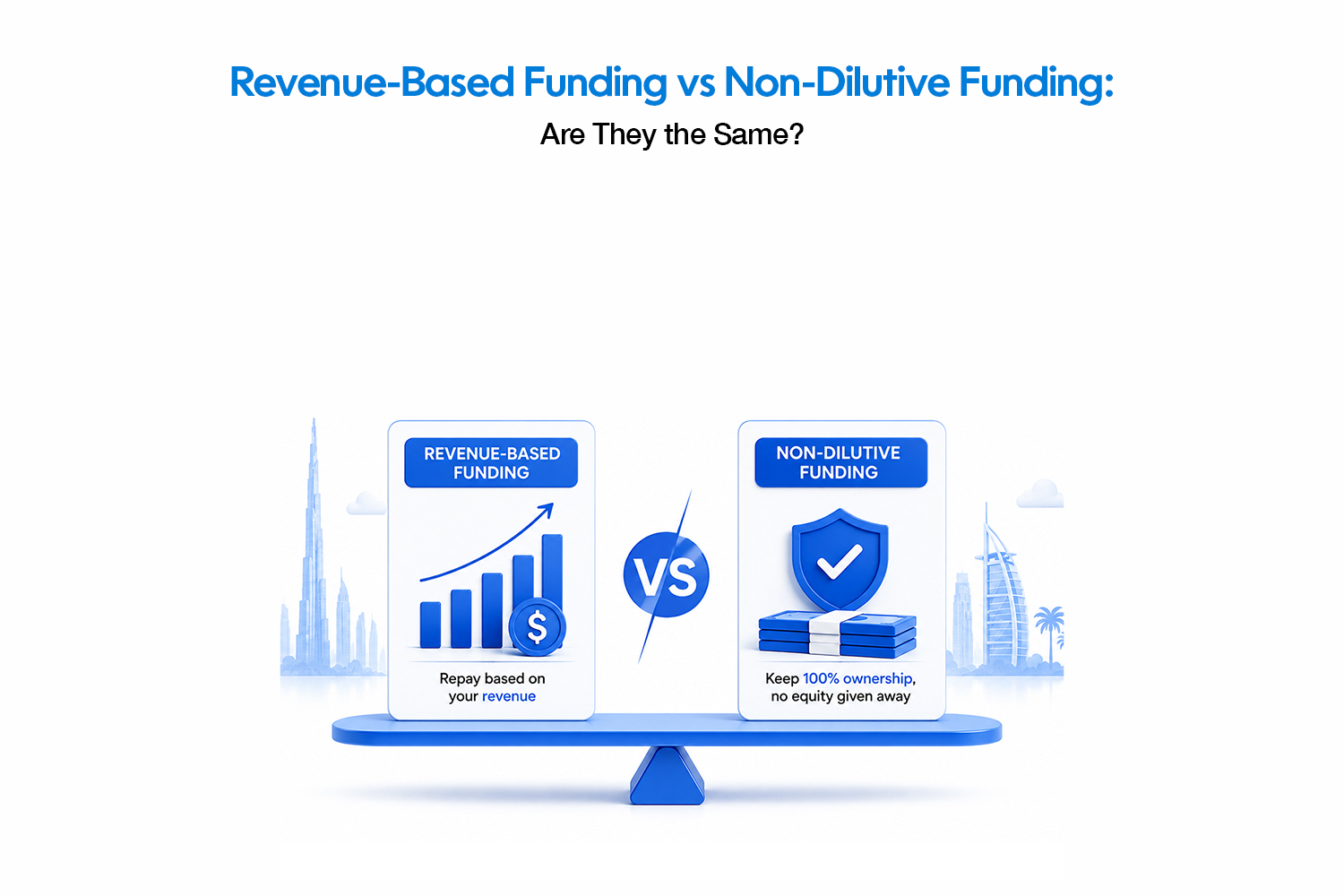
When a business needs capital to grow, founders have more choices than traditional bank loans or selling equity to investors. Two terms that frequently appear in the alternative financing space are revenue-based funding and non-dilutive funding.
But are they actually the same? Not exactly. Revenue-based funding is one type of non-dilutive financing, but non-dilutive funding is a much broader category. Understanding the difference can help business owners choose a funding option that matches their revenue, growth plans, cash-flow requirements, and ownership priorities.
What Is Revenue-Based Funding?
Revenue-based funding, also known as revenue-based financing (RBF), is a financing model where a business receives capital upfront and repays it through an agreed portion of future revenue until the agreed repayment amount is reached. Unlike equity funding, the business does not give investors an ownership stake.
For example, a growing e-commerce business could receive funding to purchase inventory or increase its marketing spend. Instead of making a traditional fixed EMI payment, repayments may be linked to the business’s revenue or sales performance, depending on the structure of the facility. This can make revenue-based financing attractive to businesses with consistent and predictable revenue streams.
What Is Non-Dilutive Funding?
Non-dilutive funding is a broader term for financing that allows a business to raise capital without giving away ownership or equity. It can include several different forms of financing, such as:
- Revenue-based financing
- Invoice discounting
- Purchase order financing
- Certain short-term working capital solutions
- Grants and other non-equity funding, depending on the context
The defining characteristic is ownership preservation. When founders raise equity financing, they sell a percentage of their company to investors. With non-dilutive financing, the founder generally retains ownership, although the business still has to meet the obligations and costs associated with the specific financing arrangement.
Revenue-Based Funding vs Non-Dilutive Funding: The Key Difference
The simplest way to understand the relationship is:
Revenue-based funding is a financing method. Non-dilutive funding is a broader financing category.
Think of it this way:
Non-dilutive funding
↓
Revenue-based financing
Invoice discounting
Purchase order financing
Other non-equity funding solutions
So, while revenue-based financing can be non-dilutive, not every non-dilutive funding solution is revenue-based financing.
Revenue-Based Funding vs Non-Dilutive Financing
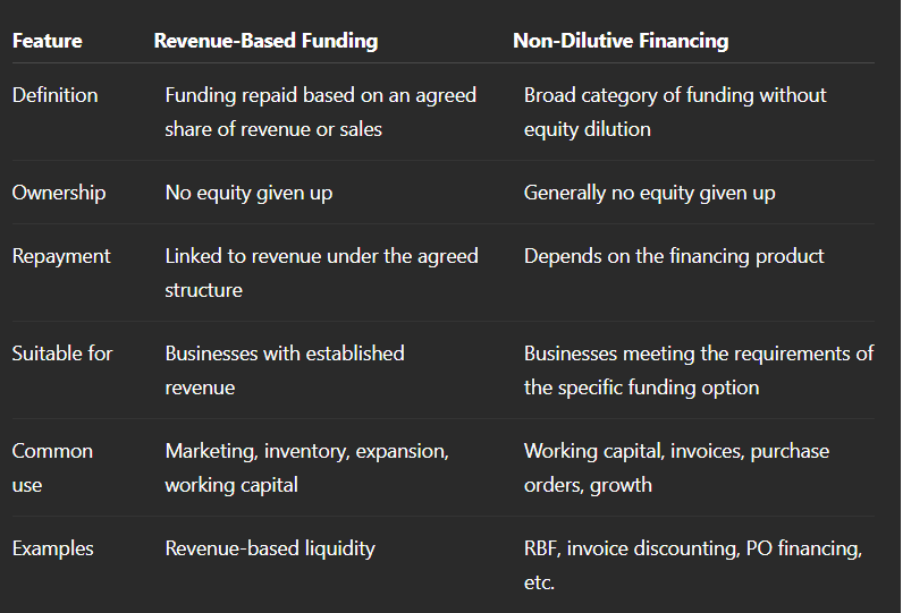
The exact repayment mechanism, fees, eligibility, and structure can vary between providers, so businesses should always review the terms of a specific facility before proceeding.
Why Are Businesses Looking at Non-Dilutive Funding?
For many founders, ownership is one of the most important considerations when raising capital. Equity funding can provide significant capital and strategic support, but it also means giving investors a stake in the company. Non-dilutive financing provides another route: access to capital without automatically transferring ownership. This can be particularly relevant for established SMEs and growth-stage businesses that already generate revenue and need capital for a specific purpose. The trend toward alternative financing is also broader than a single financing model. The OECD’s 2026 Financing SMEs and Entrepreneurs report notes that fintech-driven finance and non-bank lenders are playing an increasing role in SME access to capital. (OECD)
When Does Revenue-Based Funding Make Sense?
Revenue-based funding may be worth considering when a business:
- Has consistent or recurring revenue
- Needs capital to accelerate growth
- Wants to avoid equity dilution
- Needs funding for inventory or marketing
- Has predictable sales patterns
- Wants a financing structure linked to business performance
For example, SaaS companies, e-commerce brands, D2C businesses, and other businesses with established revenue streams may find revenue-based financing relevant. However, it may not be appropriate for every business. Companies without meaningful revenue, businesses with highly unpredictable sales, or businesses requiring very long-term capital may need to consider other financing options.
When Should You Consider Other Non-Dilutive Funding?
Non-dilutive financing is not limited to revenue-generating models. A business with strong outstanding receivables may consider invoice discounting. A company that has received a large purchase order but needs funds to fulfil it may consider purchase order financing. This is why understanding the underlying cash-flow problem is more important than choosing a financing label.
Ask yourself: What is preventing my business from growing? Is it:
- Customers paying invoices late?
- Insufficient inventory?
- A large purchase order?
- A temporary cash-flow gap?
- Marketing or expansion requirements?
The answer can help determine which type of non-dilutive financing is most appropriate.
Revenue-Based Funding and Non-Dilutive Financing in the UAE
The UAE’s growing SME ecosystem has created demand for financing solutions that can support business growth while allowing founders to retain ownership. Fincobox provides digital-first liquidity solutions for UAE SMEs, including Revenue-Based Liquidity, Invoice Discounting, Short-Term Working Capital, and Purchase Order Liquidity. For businesses with consistent online sales, Fincobox states that its Revenue-Based Liquidity solution can provide capital based on business revenue, with repayment terms that can vary according to the facility. This makes it possible for businesses to consider financing based on their actual business model and liquidity requirements rather than relying on a single funding structure.
Which Is Better: Revenue-Based Funding or Non-Dilutive Funding?
The comparison isn’t really revenue-based funding vs non-dilutive funding, because one is a subset of the other.
The better question is:
Which type of non-dilutive financing is right for my business?
If your business has predictable revenue and needs growth capital, revenue-based funding may be worth exploring. If your cash is tied up in unpaid invoices, invoice discounting may be more relevant. If you’ve received a large customer order but need capital to fulfil it, purchase order liquidity may be a better fit. The right solution ultimately depends on your revenue model, cash-flow cycle, funding requirement, and eligibility.
How Fincobox Can Help
Fincobox offers several non-dilutive liquidity solutions designed around different SME financing requirements in the UAE.
Its solutions include:
- Revenue-Based Liquidity for businesses with consistent revenue
- Invoice Discounting to unlock liquidity against eligible invoices
- Purchase Order Liquidity to help businesses fulfil eligible orders
- Short-Term Working Capital for operational liquidity needs
Fincobox states that its solutions do not require businesses to give up equity and that its liquidity is based on business performance rather than personal assets or guarantees. For businesses considering revenue-based financing or other forms of non-dilutive funding, the key is to identify the specific cash-flow requirement first and then evaluate the financing structure, cost, eligibility, and repayment terms.
Final Thoughts
So, are revenue-based funding and non-dilutive funding the same? No. Revenue-based funding is one form of non-dilutive financing. Non-dilutive funding is the broader category covering financing solutions that allow businesses to access capital without giving away equity. Revenue-based financing is one specific model where repayment is connected to business revenue under the agreed terms. For UAE SMEs, understanding this distinction can make it easier to evaluate financing options based on the actual business need—not simply the amount of capital required. Whether the requirement is growth capital, working capital, invoice liquidity, or purchase-order funding, businesses should compare the available options carefully and choose a structure that supports sustainable growth.
Frequently Asked Questions
1. Is revenue-based funding the same as non-dilutive funding?
No. Revenue-based funding is a type of non-dilutive financing. Non-dilutive funding is a broader category that includes multiple financing methods where the business does not give up equity.
2. Is revenue-based financing non-dilutive?
Generally, yes. Revenue-based financing does not require the business to sell an ownership stake in exchange for capital. However, the exact structure and terms depend on the financing provider.
3. What is the main benefit of non-dilutive funding?
The primary benefit is that founders can access capital without giving away ownership. This allows them to maintain greater control of their business while financing growth.
4. Who can benefit from revenue-based financing?
Revenue-based financing is generally more suitable for businesses with established and predictable revenue streams, including eligible SaaS, e-commerce, D2C, and other growth-stage businesses.
5. What are examples of non-dilutive financing?
Examples can include revenue-based financing, invoice discounting, purchase order financing, and certain working capital solutions. The availability and eligibility of each option depend on the provider and business.
6. Does Fincobox offer non-dilutive funding in the UAE?
Yes. Fincobox offers non-dilutive liquidity solutions for eligible UAE SMEs, including Revenue-Based Liquidity, Invoice Discounting, Purchase Order Liquidity, and Short-Term Working Capital.
7. How do I choose between revenue-based financing and invoice discounting?
Consider where your cash is tied up. If you have consistent revenue and need growth capital, revenue-based financing may be relevant. If your business has eligible unpaid invoices and needs liquidity before customers pay, invoice discounting may be more appropriate.
Leave a Reply