
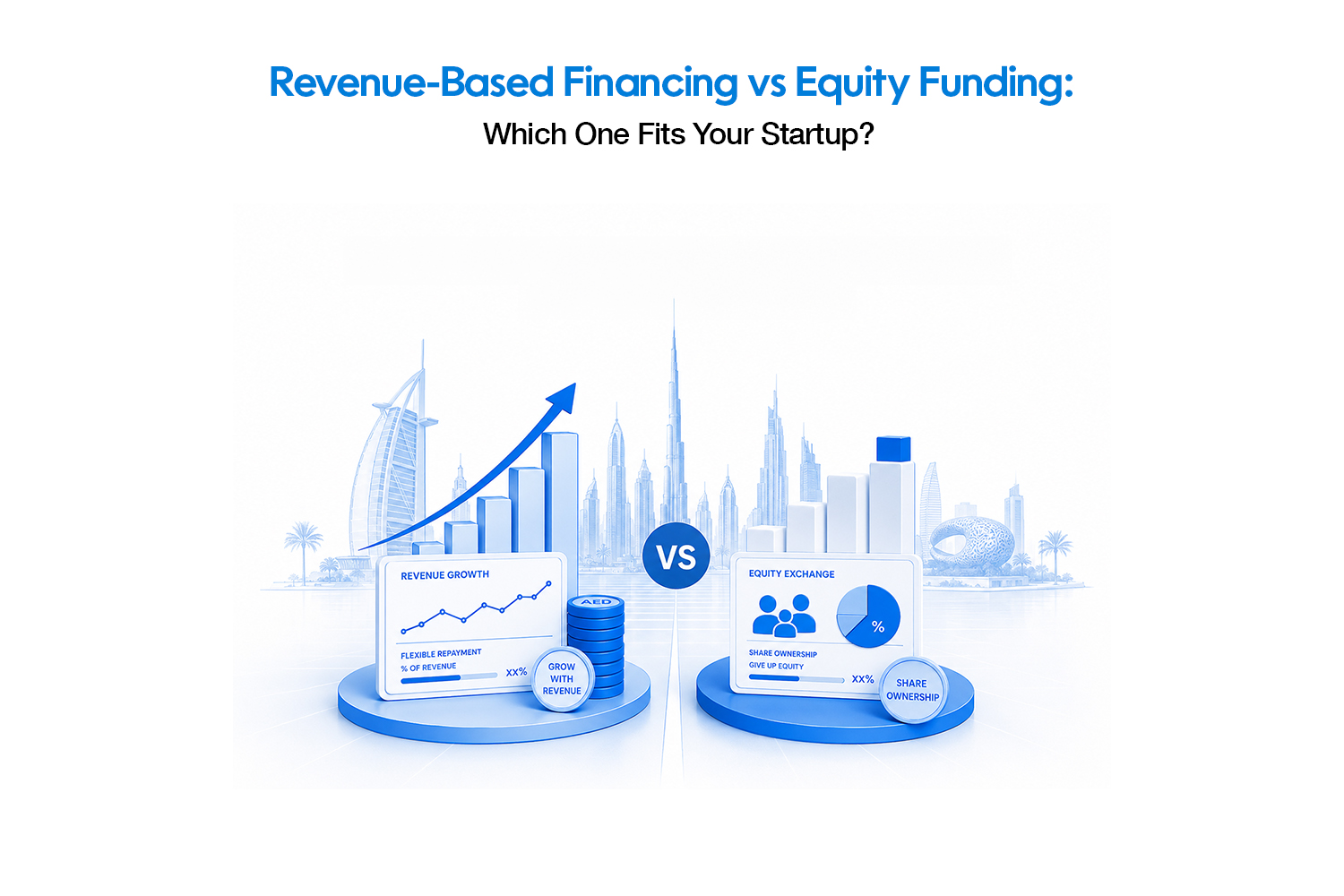
Every founder eventually hits the same wall: the business is growing, but growth needs cash. The next question is where that cash should come from and it usually comes down to two paths: revenue-based financing or equity funding. Both can fuel expansion, but they work in completely different ways, and picking the wrong one can cost a founder more than money it can cost control of the company they built.
This guide breaks down what revenue-based financing actually is, how it compares to equity funding, and how to decide which model fits your startup’s stage, margins, and growth plans.
What Is Revenue-Based Financing?
Revenue-based financing (RBF) is a funding model where a business receives upfront capital in exchange for a fixed percentage of future monthly revenue, repaid until an agreed total is reached. Unlike a traditional loan, there’s no fixed monthly EMI, repayments rise and fall with your sales. Unlike equity, there’s no ownership transferred.
For SaaS companies, D2C brands, e-commerce sellers, and other recurring-revenue businesses in the UAE, this model has become popular precisely because it aligns repayment with cash flow reality: pay more in strong months, pay less in slow ones.
Fincobox’s Revenue Based Liquidity solution is built exactly for this, SMEs get liquidity linked to their monthly revenue, with approvals in no time and no equity dilution.
What Is Equity Funding?
Equity funding means raising capital by selling a percentage of ownership in your company to investors angel investors, VCs, or private equity. In exchange for capital, investors get equity, often a board seat, and a claim on future profits or exit proceeds.
Equity funding can bring more than money: mentorship, networks, and credibility. But it also means diluting ownership permanently, sharing decision-making, and often working toward an investor-driven growth or exit timeline.
Revenue-Based Financing vs Equity Funding: Key Differences
| Factor | Revenue-Based Financing | Equity Funding |
| Ownership | No dilution — founders retain full control | Investors get a stake in the company |
| Repayment | Percentage of monthly revenue, until a cap is repaid | No repayment; investors profit via exit or dividends |
| Speed | Fast approval, often within days | Weeks to months of due diligence and negotiation |
| Best for | Businesses with steady, recurring revenue | Businesses with high growth potential but longer payback horizons |
| Cost | Fixed repayment cap, no equity cost | Ownership stake, potential loss of control |
| Flexibility | Repayments flex with revenue ups and downs | Fixed obligations to investors and board |
When Revenue-Based Financing Makes Sense
Revenue-based financing tends to fit best when:
- Your startup has predictable, recurring monthly revenue (SaaS, subscription, e-commerce, D2C brands).
- You want capital for working capital, inventory, marketing, or short-term growth not a multi-year runway.
- You’re not ready to give up equity or board control at your current valuation.
- You need funds quickly, RBF approvals move far faster than a typical equity round.
When Equity Funding Makes Sense
Equity funding is usually the better fit when:
- You’re pre-revenue or early-stage and need capital to build before revenue exists.
- Your growth plan requires large, long-horizon capital that revenue alone can’t cover in the short term.
- You want strategic partners, not just capital, investors who bring networks and expertise.
- You’re comfortable with dilution in exchange for a bigger, longer-term bet on the business.
The Real Decision: Growth Stage and Ownership Priorities
There’s no universal “better” option the right choice depends on where your startup stands. A growth-stage SME in Dubai with strong monthly revenue and a clear cash flow cycle often benefits more from non-dilutive, revenue-linked liquidity than from giving away equity for a working capital gap. An early-stage startup without revenue yet, on the other hand, may have no choice but to raise equity until revenue exists to base financing on.
Many founders also don’t treat this as an either/or decision, they use equity funding for foundational growth and revenue-based financing for ongoing working capital needs, keeping dilution to a minimum while still meeting operational cash flow gaps.
How Fincobox Helps UAE SMEs Choose the Right Path
Fincobox offers non-dilutive liquidity solutions built specifically for UAE SMEs including Revenue Based Liquidity, Invoice Discounting, and Purchase Order Liquidity with approvals in no time and funding between AED 25,000 and AED 2 Million. If your business already has revenue and you want to avoid diluting ownership, revenue-based financing can bridge the gap that equity funding would otherwise fill.
Estimate your credit limit or talk to the Fincobox team to see which funding path fits your startup today.
Frequently Asked Questions
1. What is the main difference between revenue-based financing and equity funding? Revenue-based financing provides capital repaid as a percentage of future revenue with no ownership transfer, while equity funding provides capital in exchange for a permanent ownership stake in the company.
2. Is revenue-based financing better than equity for startups?
It depends on your stage. Revenue-based financing works well for startups with steady recurring revenue that want to avoid dilution, while equity funding suits early-stage startups without revenue that need larger, longer-term capital.
3. Does revenue-based financing require collateral?
Most revenue-based financing models, including Fincobox’s Revenue Based Liquidity, are based on your revenue performance rather than fixed collateral, making them accessible to SMEs without heavy assets.
4. How fast can a UAE SME get revenue-based financing?
With Fincobox, approvals typically take 24–48 hours, compared to weeks or months for equity fundraising rounds.
5. Can a startup use both revenue-based financing and equity funding?
Yes. Many founders raise equity for long-term growth capital and use revenue-based financing for shorter-term working capital needs, minimizing overall dilution.
6. What types of businesses qualify for revenue-based financing?
SaaS companies, e-commerce and D2C brands, restaurants, and other SMEs with consistent monthly revenue typically qualify for revenue-based financing solutions like those offered by Fincobox.
Leave a Reply